"The real choice was never between this plant and nothing. It was between this plant and 107 septic tanks on steep, rocky ground above the lake." Nathan Stoops of Maverick Construction said that in a July 31 press release from the Vista Lago development team, defending a wastewater plant planned for Bremen on Smith Lake's Cullman County side.
On Smith Lake, the limit on how much gets built is not the number of lots on a plat. The limit is where the wastewater from those homes can legally go. That's true for a 107-lot subdivision, and it's true for one wooded lot you're thinking about for a weekend house.
A Subdivision That Needed Its Own Sewer
Vista Lago is marketed as a residential community on 96 wooded acres with 3,900 feet of shoreline. The developer's site lists 12 custom homesites and 95 semi-custom lots. The developer places the site where Simpson Creek meets Ryan Creek. WVTM 13 reported that it sits off County Road 143 in Bremen, that the land was once an abandoned hotel and RV resort, and that construction was underway in July.
Most of the shoreline has no municipal sewer to connect to, so the plan called for a private extended aeration treatment plant. The Alabama Department of Environmental Management put the application on public notice on April 15, 2026, with a 30-day window for written comments. ADEM issued NPDES Permit AL0084516 to Maverick Construction on May 27. The permit took effect June 1 and runs through May 31, 2031.
Here is what the permit covers, according to The Cullman Tribune's reading of the permit file:
- Treated domestic wastewater, not untreated sewage
- A design flow of 60,000 gallons per day, serving an estimated 300 people
- Engineering drawings showing two treatment trains, each designed for 30,000 gallons per day
- Outfall 1 listed 100 feet from shore, discharging continuously all year
- Ryan Creek (Smith Lake) named as the receiving water
The 60,000 gallons is the plant's design capacity. It is not a volume that is already flowing.
Why "First" Set Off the Reaction
In its May 27 response to public comments, ADEM said: "Yes, this would be the first NPDES permit to directly discharge to Lewis Smith Lake." The agency named four existing permitted facilities in the Smith Lake drainage area: Cold Springs School WWTP, Good Hope WWTP, Double Springs WWTP and the Addison Lagoon and Sprayfield. None of them discharges directly into the lake. Three discharge to creeks or tributaries, and Addison uses land application. The Tribune also reported that ADEM said no water-quality model for Smith Lake currently exists.
The public accounts disagree on where the water would actually go. The developer's July 31 release describes an outfall about one-third of a mile from the Ryan Creek shoreline, with treated water running overland at 10 to 15 gallons per minute. ADEM's permit record lists the outfall 100 feet from shore. That gap was never publicly resolved.
According to ABC 33/40, Black Warrior Riverkeeper opposed the permit, citing Ryan Creek's impaired water quality and its pathogen TMDL. The Cullman Tribune reported that the Smith Lake Environmental Preservation Committee opposed any direct effluent discharge and asked for a public meeting. According to The Cullman Times, State Rep. Cindy Myrex said delegates lack the authority to interfere in ADEM's permitting process, and she committed to meeting with residents and developers.
On August 17, Stoops announced that the team would explore alternative discharge options.
The Fix Turned Out to Be Land
On October 5, Maverick Construction filed a modification with ADEM to swap the surface discharge for about four acres of underground engineered drip fields. The same 60,000-gallon-per-day plant stays in place. "Every gallon still goes through the same treatment plant first," Stoops told The Cullman Tribune. "The only thing that changes is where the treated water goes once it leaves the plant."
The Tribune reported that the filing's cover letter, from Landmark Engineering Group engineer Michael Shamsie, puts the drip fields just west of the main entrance in an area set aside as open space. The paper also noted that the original application listed land as unavailable for land application, and the new 125-page filing does not explain how four acres became available.
This is the part that matters if you're buying anywhere on the lake. When a direct discharge became politically hard, the fallback was ground: acreage, soil and room to spread treated water underground. Individual lake lots run on the same principle, just smaller and with less oversight.
The Same Rule, Scaled Down to One Lot
When a property has no municipal sewer, the Alabama Department of Public Health says the site must be soil-tested for a septic system. The owner applies to the county health department, and work can't start until that department issues a Permit to Install. Four provisions in the state's onsite sewage rules, Chapter 420-3-1, do most of the work:
- Room for two fields, not one. Rule 420-3-1-.10 requires the lot to fit the house, the disposal field, a 100 percent replacement field and every required setback.
- Water doesn't count as lot. The same rule leaves reservoirs, impoundments, drainage areas and wetlands out of the lot-size calculation. Minimum lot sizes come from Table 17 and depend on the lot's recording date.
- The worst soil feature decides. Under Rule 420-3-1-.37, the site evaluation looks at permeability, seasonal saturation, restrictive layers, slope and landform, and the most limiting factor sets what kind of system the site can take.
- Changes reopen the file. Rule 420-3-1-.32 requires a repair permit for anything beyond maintenance. Added flow gets evaluated by the health department, and moving a system means applying as if it were new. Design flow for a home is figured from Table 1 under Rule 420-3-1-.52.
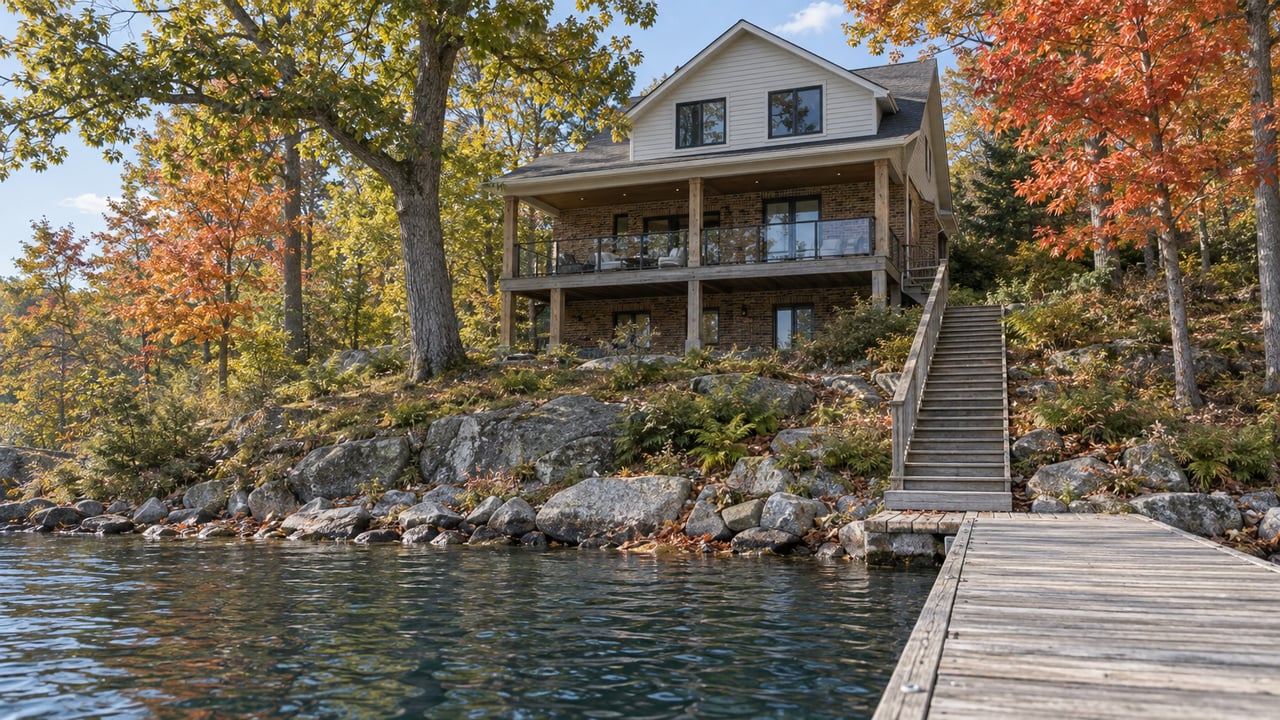
Steep, rocky shoreline is exactly where those provisions bite. A lot can have great frontage and still run short of usable soil once the disposal field, the full replacement area and the setbacks are laid out.
Alabama Power adds its own step. Its Smith Lake shoreline guidelines, revised July 15, 2025, require local health-department sanitation certification with a permit application for an elevated single-family structure. They also say septic systems must be approved by the proper authorities before a permit is issued and construction begins.
Where the Two Approaches Differ
The density math in the rules explains why a large developer would accept a permit fight. Rule 420-3-1-.10 lets advanced treatment systems that are owned and operated by a wastewater management entity, government agency or cooperative, under a Performance Permit, size the replacement area at half the design flow with ADPH approval. Engineered systems can also bring lot sizes below the Table 17 minimums.
| Individual lot septic | Vista Lago's proposed plant | |
|---|---|---|
| Who approves it | County health department | ADEM, under NPDES Permit AL0084516 |
| Land it needs | Disposal field plus a 100% replacement field on each lot | About four acres of shared drip fields under the October filing |
| Ongoing testing | None described in the developer's comparison | Weekly testing and monthly public reports, per the developer |
| Who operates it | Not stated in the developer's comparison | An independent state-licensed operator, per the developer |
The developer's comparison goes further. Its July 31 release says a septic tank removes only 25 to 40 percent of the waste that enters it, and that nobody tests or monitors those systems. It also says the plant is designed to release water 20 times cleaner than conventional septic runoff. Those are the project team's own claims, made in defense of its permit. Under the state rules, clustered homes need a regulated plant and a public permit. Scattered homes need enough good ground, lot by lot.
Where It Stands Before Winter
As of mid-October, ADEM had not approved the modification, and its public-notice index showed no notice or comment dates for it. Readers who want to follow the next step can watch ADEM's public notices page and the Tribune's Vista Lago coverage.
Quick Answers
Does the Vista Lago permit allow raw sewage into Smith Lake? No. The permit authorizes treated domestic wastewater and does not authorize routine discharge of untreated sewage.
Is the drip-field plan in effect? Not yet. It's a pending modification application filed October 5.
Does adding a bedroom to a lake house touch the septic permit? Rule 420-3-1-.32 says increased flow is evaluated by the county health department, and home design flow comes from Table 1. The current tables and your county health department control the details.
This post is general information, not legal or engineering advice. Before you buy, build or expand, confirm what a specific property allows with the county health department, Alabama Power and the right licensed professional.
If you're looking at a Smith Lake lot or a lake home you hope to expand, the soil evaluation and septic records belong at the start of due diligence, right next to the dock and the water depth. Jay Barrett has spent 36 years working with lake and acreage property around Smith Lake and can help you line up those questions before you commit. Schedule a Free Consultation.